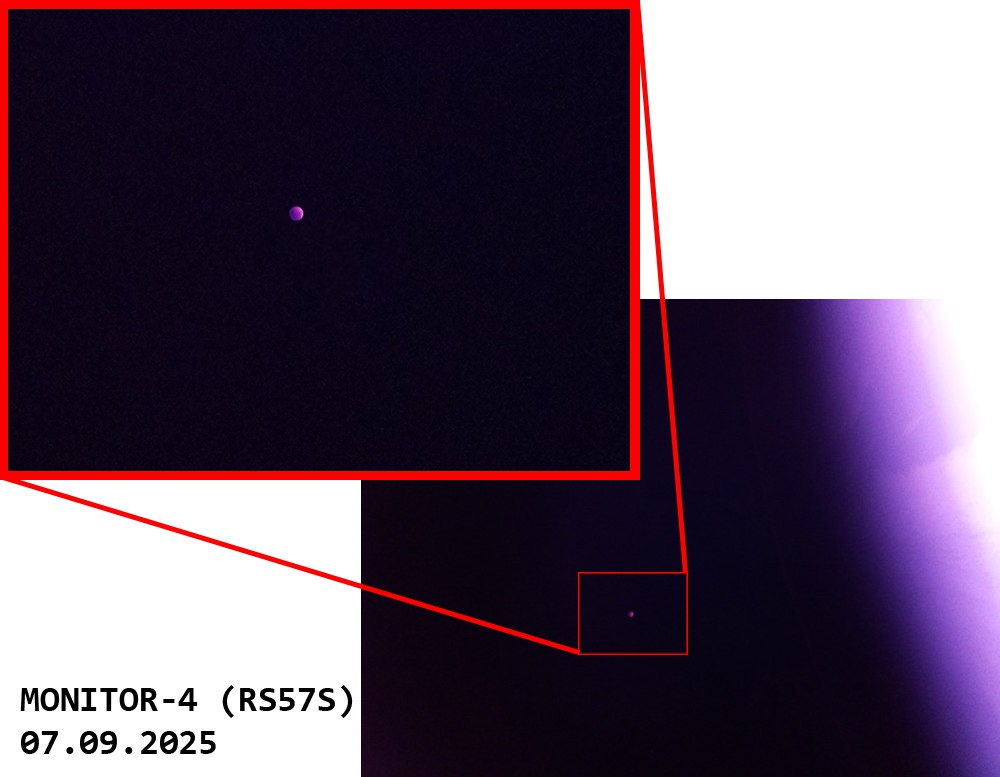
The small spacecraft "Monitor-4", developed and built with the participation of specialists from the Radiation Monitoring Lab of SINP MSU, successfully conducted a unique imaging session of the lunar eclipse on September 7th. While the satellite's primary mission is the observation of cosmic flashes in the X-ray and gamma-ray ranges, this experiment demonstrated the platform's broad potential.
Imaging such an event from a satellite is a complex technical task. To accomplish it, the development team had to plan the spacecraft's operation cycle with high precision to orient the camera towards the Moon at the calculated time and capture the planned series of images.
Following the successful imaging, the data was transmitted to Earth via a network of radio amateurs, who received and saved the unique photographs.
The "Monitor-4" project is part of the larger scientific and educational project Constellation-270 of the MSU "Cosmos" Research and Education School and the federal program Space Pi.
Imaging such an event from a satellite is a complex technical task. To accomplish it, the development team had to plan the spacecraft's operation cycle with high precision to orient the camera towards the Moon at the calculated time and capture the planned series of images.
Following the successful imaging, the data was transmitted to Earth via a network of radio amateurs, who received and saved the unique photographs.
The "Monitor-4" project is part of the larger scientific and educational project Constellation-270 of the MSU "Cosmos" Research and Education School and the federal program Space Pi.
